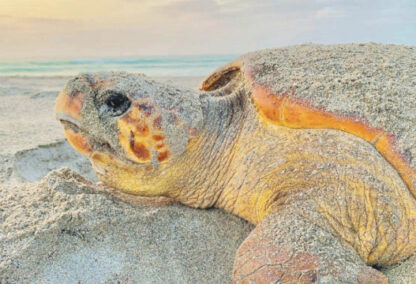
Oman has invested considerable resources in protecting wild life and the marine life around its coastal waters and one of the most popular sights for visiting environmentalists are the turtles which nest along the largely secluded coastline.
Oman boasts many environmental treasures, especially along its beautiful 1,700-kilometre coastline. The sultanate’s crystal clear waters and mile upon mile of deserted white sandy beaches support a vast array of marine life. Dolphins arc in and out of the deep blue water just yards offshore while beneath the waves a magnificent selection o f brightly coloured fish weave in and out of the largely pollution-free coral reefs of the Indian ocean.
A regional secret
For many years a regional secret, Oman’s aquatic treasures have, in recent years, attracted increasing international attention. Tourists from around the world are travelling to the sultanate to enjoy the weather, the warmth of Omani hospitality and the magnificent spectacle of marine life unfettered by man-made lagoons or aquaria.
Among Oman’s shyest and most sought after natural wonders are the turtles, which appear annually to lay their eggs on the very beaches where they were first hatched.For 90 million years and more, turtles have travelled the world’s oceans, emerging on beaches only to lay their eggs. Oman’s beaches are home to four main turtle species, namely the Green turtle, the Olive Ridley, the Hawksbill and the Loggerhead; another less common visitor that lives and feeds in these waters is the giant leatherback turtle but there is no known evidence of the leatherback nesting locally.
Oman’s beaches are amongst the most important nesting sites for the Green turtles in the Indian Ocean region; an estimated 20,000 turtles nest on more than 260 beaches dotted along the country’s coastline every year, producing millions of eggs. The beaches have been declared of international importance and are part of the Turtle Natural Reserve, set up by the late Sultan Qaboos bin Said in 1996.
The sultanate has now carried out special studies and has implemented measures aimed at the conservation of turtles. All turtles are under threat at every stage of their long lives. Natural threats and, more recently, man-made threats have left all species in danger of extinction.
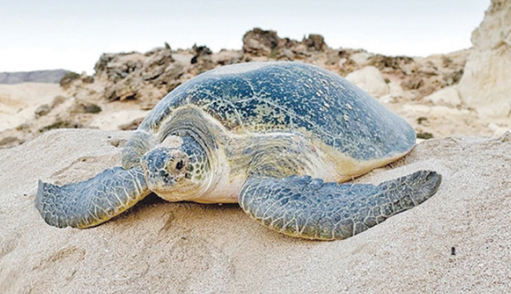
The turtles lay their eggs on Omani beaches, after a laborious journey from the seashore between April and September and always travel to the same beach where they struggled, as tiny hatchlings, to survive the short but dangerous journey to the seashore, avoiding predatory seagulls, foxes and other wildlife, during the nesting season.
At sunset, we walk along the beach of Ra’s Al Hadd, which attracts as many as 13,000 green turtles annually, noticing tracks from the previous night and a number of broken eggs. This is a beach where there have been turtles, very recently. As darkness falls we retreat to the sand dunes above the beach where we lie enjoying the balmy warmth of the evening, listening to the waves lap the seashore and watching the stars glistening above us like a multitude of diamonds thrown haphazardly on a deep navy blue velvet display case. On the shoreline, beads of natural sulphur deposits glow silver in the dark, lending an eerie, almost supernatural feel to this setting.
A monumental feat
As they leave the waters of the Indian Ocean, where they swim so adroitly and elegantly for most of their lives, the turtles become awkward and ungainly as they haul their heavy bodies, weighing around 130-160 kilogrammes and measuring up to one metre long, up the beach.
The turtle hauls her heavy body up the beach; arriving at a suitable spot, the female makes a ‘swimming’ motion in the sand, until she has creating a deep crater in which to lay her eggs. The displaced sand creates a virtual localised storm as she digs deeper and deeper in an attempt to ensure a place of safety. Should the hole collapse or feel unsafe at any point, the female turtle will move on, further up the beach, and begin the whole onerous process again from scratch.
Once she is satisfied with the depth, shape and size of the hole, she begins the lengthy job of laying the precious eggs. About the size and shape of a leathery-cased ping pong ball, the female turtle will produce about 120 eggs per clutch. They are then covered deep in the sand, away from preying eyes and, hopefully, hungry predators, where they will take 60 days to hatch. Once her task of laying is complete the female turtle heads off slowly back to sea. She will lay up to three times in a season. There is no caring parent in this reptilian family to watch over the eggs or the hatchlings. It is the warmth of the sand that incubates them. When hatched, if the tiny hatchlings can reach the water’s edge without being caught it could be more than 40 years before they return to these to these beaches again to lay their own eggs, an awesome thought.
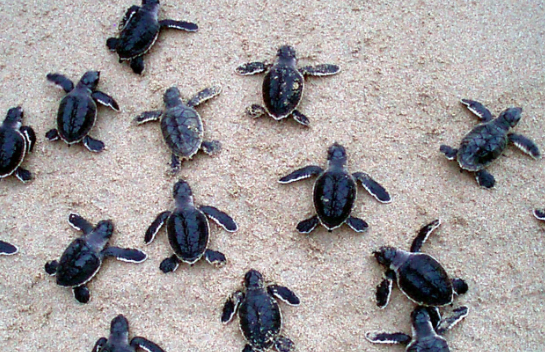 Once in the sea, hatchlings swim energetically to get past the nearshore predators. It is believed they swim non-stop for a week, obtaining sustenance from a residual yolk sac. But surprisingly little is known about the first year of a hatchlings life. Scientists assume that during this time the young turtles drift on ocean currents, feeding on plankton. A year later, the survivors reappear inshore having grown to a length of about 20 centimetres, and begin to settle into a pattern of life.
Oman takes its responsibilities towards the turtles seriously. The casual tourist is not permitted onto nesting beaches unless accompanied by a ranger. The lighting of fires in the near vicinity is strictly prohibited, as is the use of flash photography which might cause distress to laying females. All rules pertaining to the wellbeing of the turtles are strictly enforced.
The sight of the turtles heaving themselves beyond the high water line to deposit their eggs is unquestionably a moving experience and one most people would feel privileged to witness, but it is vital for environmental conservation that the rules are respected if forthcoming generations are to be allowed to enjoy these same momentous sights in Oman.

